
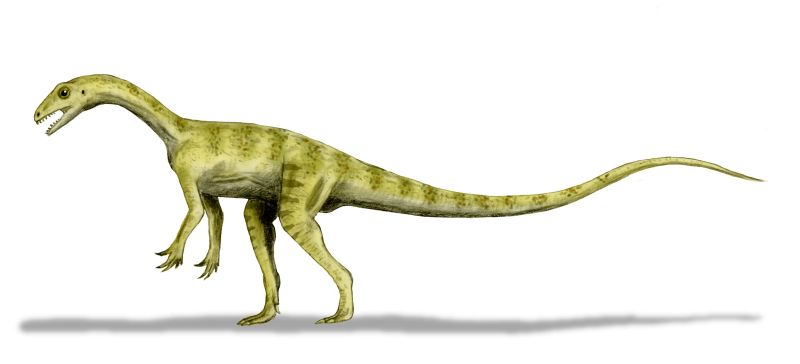


Pantydraco was a genus of basal sauropodomorph dinosaur from the Late Triassic to Early Jurassic. The word "panty" is short for Pant-y-ffynnon which refers to the Bonvilston quarry in south Wales where it was found. It was based on a partial juvenile skeleton once thought to belong to Thecodontosaurus. It represented a basal sauropodomorph known from Europe and considered to be probably omnivorous. It was most likely primarily bipedal.
The Pantydraco dinosaur was of moderate build, a medium-sized dinosaur and was about the height of a full-grown adult. It had a long tail that tapered towards the end and was broad at the hip joint. The head was dragon-shaped with a strong jaw. It had forelimbs for grasping prey while the hind limbs were adapted to support the creature's body weight. The forelimbs were shorter than the hind limbs. The limbs were robust to maintain body weight. Its hands had three movable digits while the fourth digit was embedded. It came with sharp claws to catch and hold the prey of carnivorous mammals.
Pantydraco hunted on smaller animals that could be easy prey for the agility and flexibility of this dinosaur. Like all other known prosapods of that time, the creature fed on the flesh of small insects and dinosaurs. Its estimated size was 3 m long and it weighed 50 kg.
Pantydraco was considered omnivorous, meaning that it ate both plants and animals. The creature used to feed on the flesh of small insects and dinosaurs.
The word "panty" is short for Pant-y-ffynnon which refers to the Bonvilston quarry in South Wales where it was found.
The estimated size of the Pantydraco was 3 m long and weighed 50 kg.
Pantydraco was a genus of basal sauropodomorph dinosaur from the Late Triassic to the Early Jurassic, about 208.5 million years ago - 201.3 million years ago.
Pantydraco was discovered in the Pant-y-ffynnon quarry in the province of Bonvilston in Wales.


 English
  Español
  Español de México
  Español de Colombia