
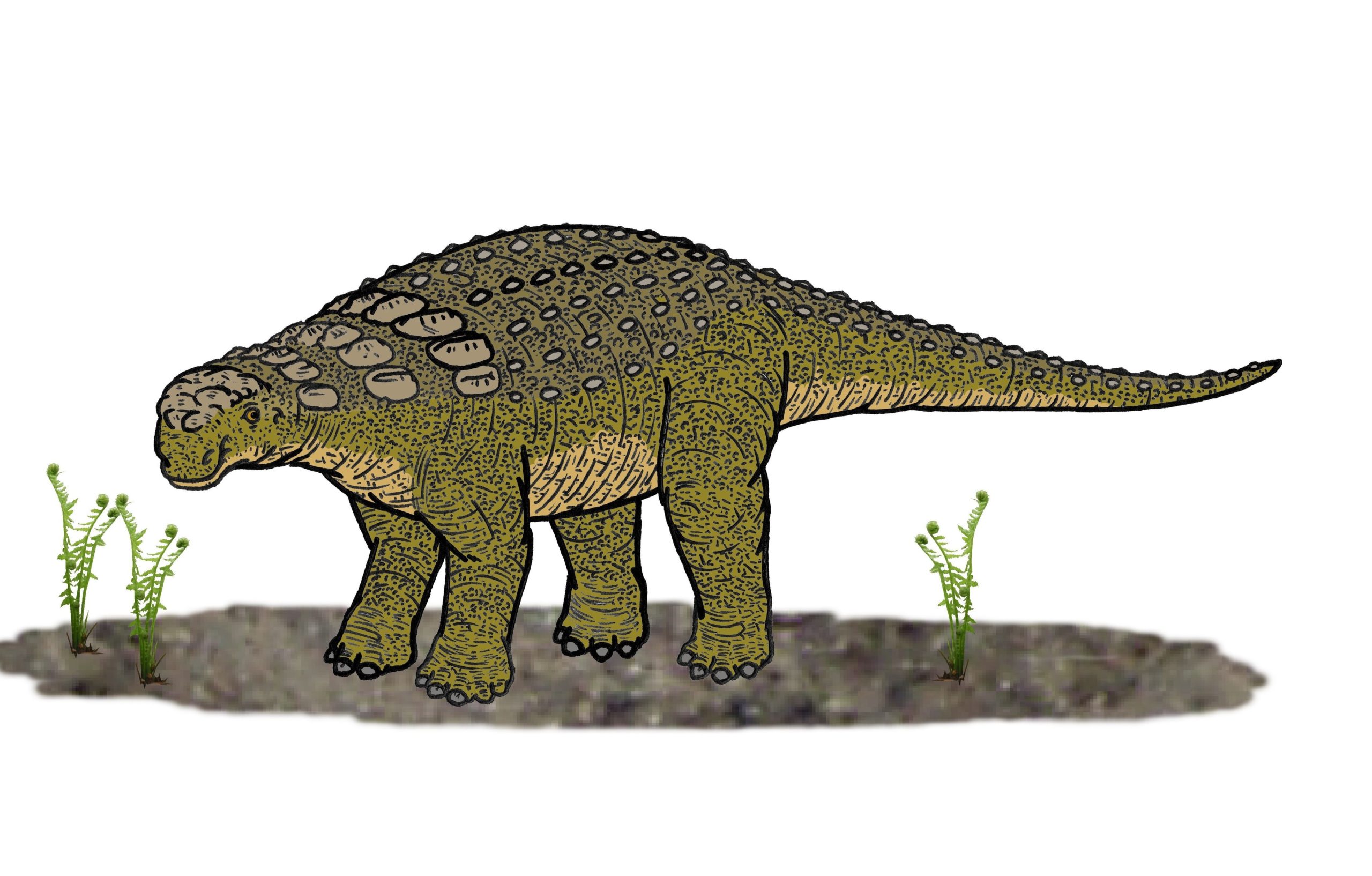


Panoplosaurus was a genus of nodosaurid dinosaur that lived during the late Cretaceous. They were known to be the last nodosaurs living in the Late Cretaceous in North America. The fossils were found in Alberta, Canada. It was named by Canadian paleontologist Lawrence Lambe in 1919. The name comes from the Greek words meaning "fully armored lizard".
Panoplosaurus was a heavily armored dinosaur that had studded plates covering its back and tail. Unlike ankylosaurs, its tail lacked the club. Large paired ovals were keeled, possessing a prominent curved ridge on the outer surface of the bony armor that covered the neck, shoulders, and forelimbs. It had shoulder spikes, the head had a compact helmet shield, and the cheek had scutes. Its skull was broad and short at the back. It had a relatively narrow snout, and the hands had only three fingers.
The skull was short and broad posteriorly. The head of the holotype specimen was unusually rounded; the other two skulls were longer and flatter, perhaps reflecting age or gender differences.
Panoplosaurus was 5 to 7 meters long, about 2 meters tall, and weighed an estimated 1.5-1.6 tons.
The name Panoplosaurus comes from the Greek words meaning "fully armored lizard".
Panoplosaurus was a plant-eating animal that digested all types of plants, including grasses.
The fossils were found in Alberta, Canada, and were named by Canadian paleontologist Lawrence Lambe in 1919.


 English
  Español
  Español de México
  Español de Colombia