
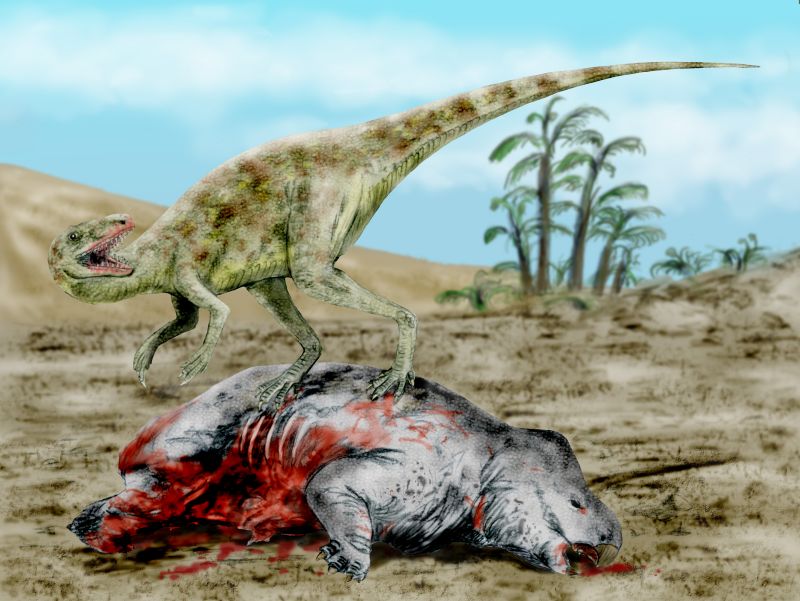


Staurikosaurus was a genus of Herrerasaurid dinosaur from the Late Triassic period, 225 million years ago, precisely the Carnian era. At the time of Carnian, it was a small theropod dinosaur, but one of the earliest known dinosaurs. The name means "Southern Cross Lizard" in reference to a constellation only seen in the southern hemisphere. In 1936, it was discovered in the lowlands of the Santa Maria Formation in southern Brazil by paleontologist Llewellyn Ivor Prince.
It had a long, rather thin head with several sharp teeth and powerful jaws for tearing flesh and crushing bone through the meat it ate. Because of its large dolphin eyes, it was not able to see its surroundings very well in depth. The animal had a relatively long, slender neck and body designed to reach the small, fast animals it fed on or more dangerous predators such as the menacing Saurosuchus.
It had long arms with five toes and hooked claws for grasping small prey. It had long legs with three toes and sharp claws at the end of each. The tail also extended to help balance this sleek theropod as it ran.
Staurikosaurus was estimated to be about 80 cm tall, 2.2 m long and weighed between 10 and 30 kg.
The name means "Southern Cross Lizard" in reference to a constellation that is only seen in the southern hemisphere.
In 1936, it was discovered in the lowlands of the Santa Maria Formation in southern Brazil by paleontologist Llewellyn Ivor Prince.
Staurikosaurus was a carnivore with several sharp teeth and powerful jaws for tearing flesh and crushing bone through the flesh it ate.


 English
 Español
 Español de México
 Español de Colombia