Warning: Undefined array key "paged" in /nas/content/live/abcdino1/wp-content/themes/astra-child/functions.php on line 41

Warning: Undefined array key "paged" in /nas/content/live/abcdino1/wp-content/themes/astra-child/functions.php on line 41
The Agilisaurus - Dinosaur - Learn More | ABCDino
Warning: Undefined array key "paged" in /nas/content/live/abcdino1/wp-content/themes/astra-child/functions.php on line 41

Agilisaurus

To the best of our knowledge images are available by CC.

Learn more about Agilisaurus

Quick Facts
NameAgilisaurus
Diet
Weight40 kg
Length1.5 meters
Height0.6 meters
Period
Agilisaurus
Human

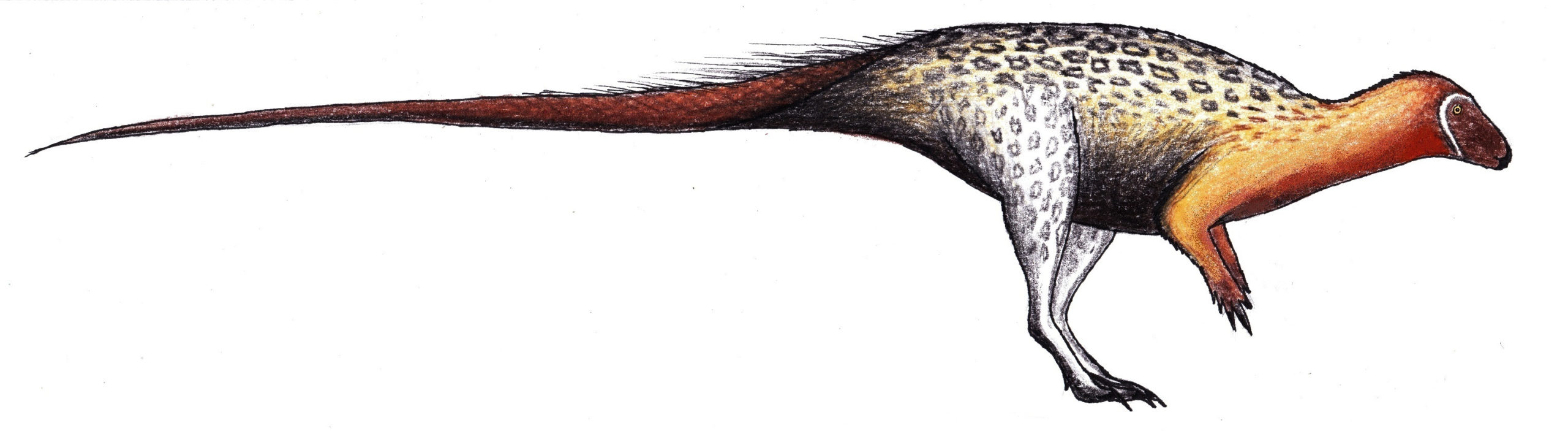
Agilisaurus was a genus of ornithischian dinosaurs that lived in the Middle Jurassic period of eastern Asia, about 170.3 million years ago, i.e. 163.5 million years ago. The name means "agile lizard", which has been derived from the Latin word "agilis", meaning agile, and the Greek word "sauros", meaning lizard. In 1990, Peng gave it the name and it used to live in the wilds of ancient China. 

It was a bipedal dinosaur with a long hind tail and a stiff tail, showing that it could run very fast. It was an herbivorous dinosaur that ate a combination of leaves, twigs and seeds. The upper and lower jaws have a beak-like structure, evidence that they fed on plant material. It was known to be diurnal in nature, meaning that it was active during the day and rested during the night. 

Agilisaurus was about 4 feet long and weighed about 40 kg.

What is the meaning of Agilisaurus?

The name Agilisaurus means "agile lizard", which has been derived from the Latin word "Agilis", meaning agile, and the Greek word "sauros", meaning lizard.

When did Agilisaurus live?

Agilisaurus was a genus of ornithischian dinosaurs that lived in the Middle Jurassic period of eastern Asia, about 170.3 million years ago, i.e., 163.5 million years ago. 

What was the size of Agilisaurus?

Agilisaurus was about 4 feet long and weighed about 40 kg.

Where did they live?

When did they live?

What was your diet?

Who discovered them?

What kind of dinosaurs are they?

What type of species are they?

  • Peng G. 1990. [A new small ornithopod (Agilisaurus louderbacki gen. et sp. nov.) from Zigong, China]. Newsletter of the Zigong Dinosaur Museum 2: 19-27. [in Chinese]
  • Peng G. 1992. Jurassic ornithopod Agilisaurus louderbacki (Ornithopoda: Fabrosauridae) from Zigong, Sichuan, China. Vertebrata PalAsiatica 30: 39-51. [in Chinese]
  • Schmitz, L.; Motani, R. (2011). "Nocturnality in Dinosaurs Inferred from Scleral Ring and Orbit Morphology". Science 332. PMID 21493820. doi:10.1126/science.1200043. 
  • Weishampel, D.B., Jianu, C.-M., Csiki, Z., & Norman, D.B. Osteology and phylogeny of Zalmoxes (n.g.), an unusual euornithopod dinosaur from the latest Cretaceous of Romania. Journal of Systematic Palaeontology 1: 65-123.
  • Norman, D.B., Sues, H-D., Witmer, L.M., & Coria, R.A. 2004. Basal Ornithopoda. In: Weishampel, D.B., Dodson, P., & Osmolska, H. (Eds.) The Dinosauria (2nd Edition). Berkeley: University of California Press. Pp. 393-412.
  • Xu X., Forster, C.A., Clark, J.M., & Mo J. 2006. A basal ceratopsian with transitional features from the Late Jurassic of northwestern China. Proceedings of the Royal Society B: Biological Sciences. doi:10.1098/rspb.2006.3566 [published online].
  • Barrett, P.M., Butler, R.J., & Knoll, F. 2005. Small-bodied ornithischian dinosaurs from the Middle Jurassic of Sichuan, China. Journal of Vertebrate Paleontology 25(4): 823-834.
  • Butler, R.J. 2005. The 'fabrosaurid' ornithischian dinosaurs of the Upper Elliot Formation (Lower Jurassic) of South Africa and Lesotho. Zoological Journal of the Linnean Society 145: 175-218.
  • Butler, Richard J.; Upchurch, Paul; and Norman, David B. (2008). "The phylogeny of the ornithischian dinosaurs". Journal of Systematic Palaeontology 6 (1): 1-40. doi:10.1017/S1477201907002271.
geological time 3

Fun Facts

  • The name Agilisaurus means "Agile Lizard", which has been derived from the Latin word "Agilis", meaning agile, and the Greek word "sauros", meaning lizard.
  • It was a bipedal dinosaur and may have walked on four legs.
  • It was an herbivorous dinosaur.
  • In 1990, Peng gave it a name and lived in the wilderness of ancient China. 
  •  It was known to be diurnal in nature, meaning that it was active during the day and rested during the night.

More to Explore!

en_USEnglish

Pin It on Pinterest

Share This

Warning: Undefined array key "paged" in /nas/content/live/abcdino1/wp-content/themes/astra-child/functions.php on line 41