
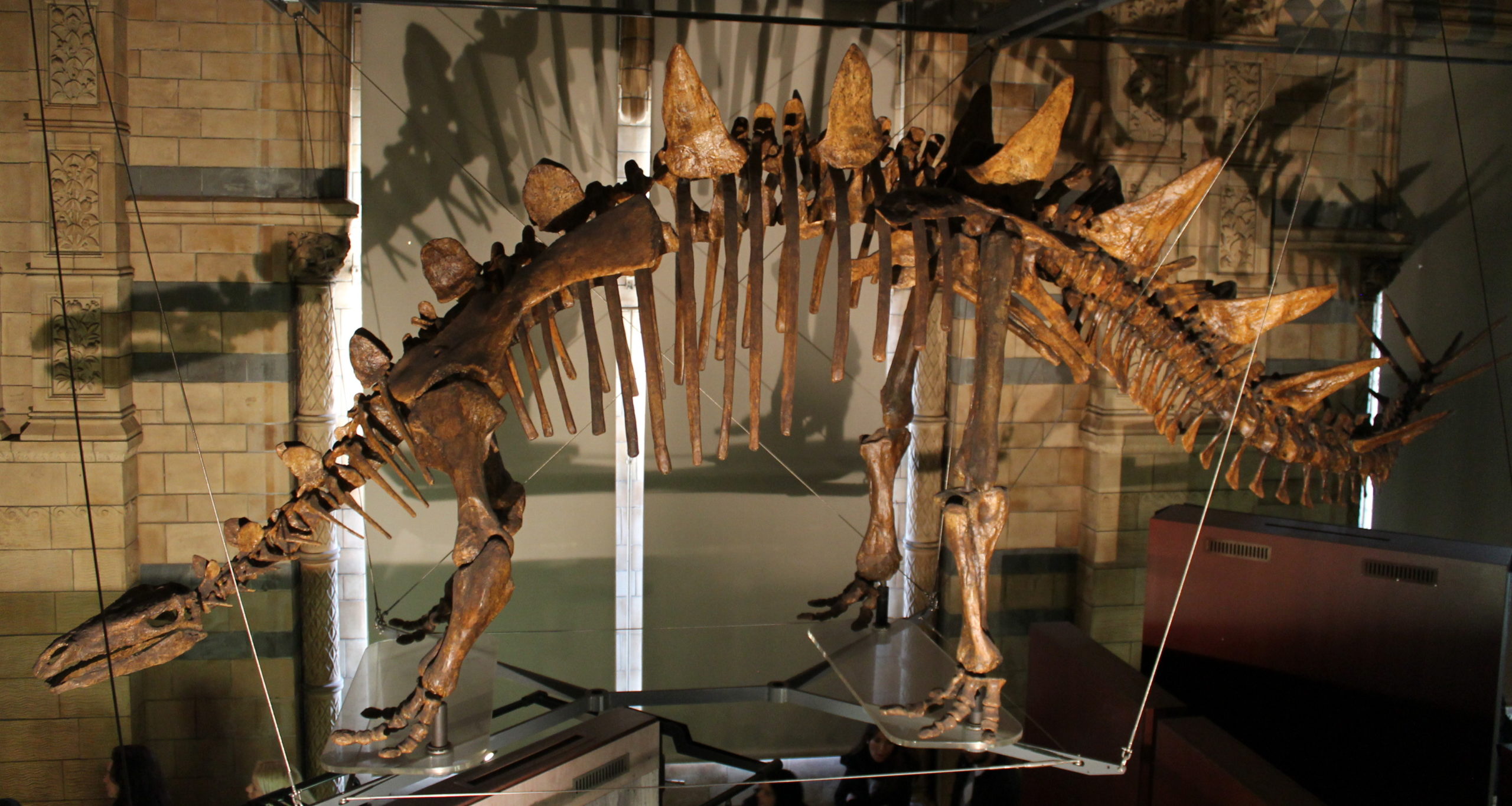



Tuojiangosaurus was a genus of herbivorous stegosaurian dinosaurs from the Late Jurassic period, about 161 to 146 million years ago. It was the first stegosaur discovered in China. In 1977, it was named and described by Othniel Charles Marsh. The name means "lizard of the Tuo River".
It was a bulky, rhinoceros-sized beast with an arched back and pillar-like limbs. The color of the somewhat shiny plates and spikes along its back and tail came into view. It had 17 pairs of thick, narrow plates. The tallest pairs of the Tuojiangosaurus were at the highest point of its back. The two pairs of spikes grew from the end of its tail. At the end of its tail were four sharp spines. It was a slow-moving quadrupedal dinosaur that fed on low vegetation. For such a vast body, it had a small head and low teeth like other stegosaurs better suited for use on softer vegetation that did not require much tugging to remove from primary plants. Its head was close to the ground where thicker vegetation grows.
Cases that occurred as Tuojiangosaurus were sometimes interrupted by battles with predators or fights with another male Tuojiangosaurus for females. Tuojiangosaurus did not have spikes and bony plates when they hatched, but developed slowly as Tuojiangosaurus grew.
Tuojiangosaurus was up to 7 meters long, 2 meters high, and weighed about 4 tons.
The name Tuojiangosaurus means "lizard of the Tuo River".
Tuojiangosaurus was a genus of herbivorous stegosaurian dinosaurs of the Late Jurassic period some 161 to 146 million years ago.
It was a plant-eating dinosaur that fed on low vegetation.
Tuojiangosaurus was found in the Upper Shaximiao Formation of what is now Sichuan Province in China.


 English
  Español
  Español de México
  Español de Colombia