
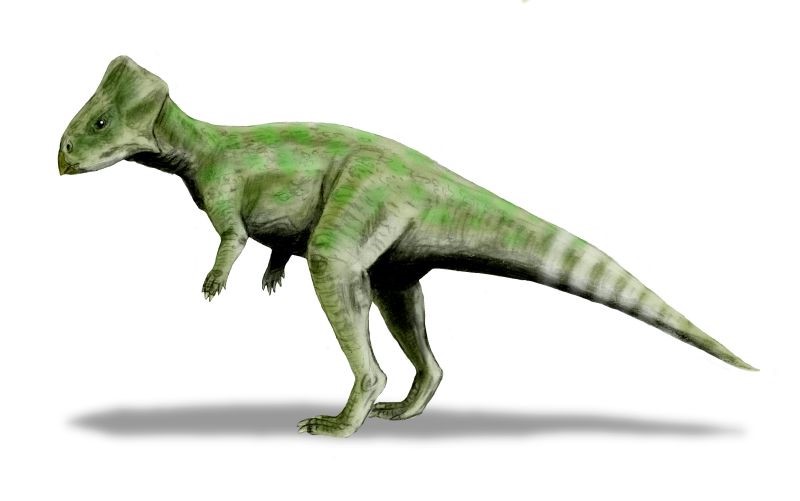

Graciliceratops is a genus of neoceratopsian dinosaurs from the Late Cretaceous of China. Its name means "graceful horned face" because it was a very graceful ceratopsian. The fossils were found in the Shireegiin Gashuun in the Gobi Desert of Mongolia, north of the Nemegt Basin. In 1975, it was initially described by Maryanska and Osmolska as Microceratops gobiensis, but later, Paul Sereno reclassified it as a new genus and species as Graciliceratops mongoliensis in 2000.
It was a small and lightly built ceratopsian dinosaur, recognized by its fragile frond and its characteristic tibio-femoral relationship. Its frond was elongated with well-developed squamous processes. It was a bipedal dinosaur, but capable of adopting a quadrupedal posture when browsing on low-growing vegetation. It was a herbivorous dinosaur with a cutting beak that would have been able to cut parts of plants.
It is estimated that Graciliceratops was about 60 cm long and weighed between 2.27 and 9.1 kg.
It was a herbivorous dinosaur with a cutting beak that would have been able to cut parts of plants.
The name means 'graceful horned face' because it was a very graceful ceratopsian.
The fossils were found in the Shireegiin Gashuun in the Gobi Desert of Mongolia, north of the Nemegt Basin.


 English
  Español
  Español de México
  Español de Colombia