Warning: Undefined array key "paged" in /nas/content/live/abcdino1/wp-content/themes/astra-child/functions.php on line 41

Warning: Undefined array key "paged" in /nas/content/live/abcdino1/wp-content/themes/astra-child/functions.php on line 41
The Anserimimus - Dinosaur - Learn More | ABCDino
Warning: Undefined array key "paged" in /nas/content/live/abcdino1/wp-content/themes/astra-child/functions.php on line 41

Anserimimus

To the best of our knowledge images are available by CC.

Learn more about the Anserimus

Quick Facts
NameAnserimimus
Diet
Weight50 kilos
Length3.5 meters
Height
Period
Anserimimus
Human

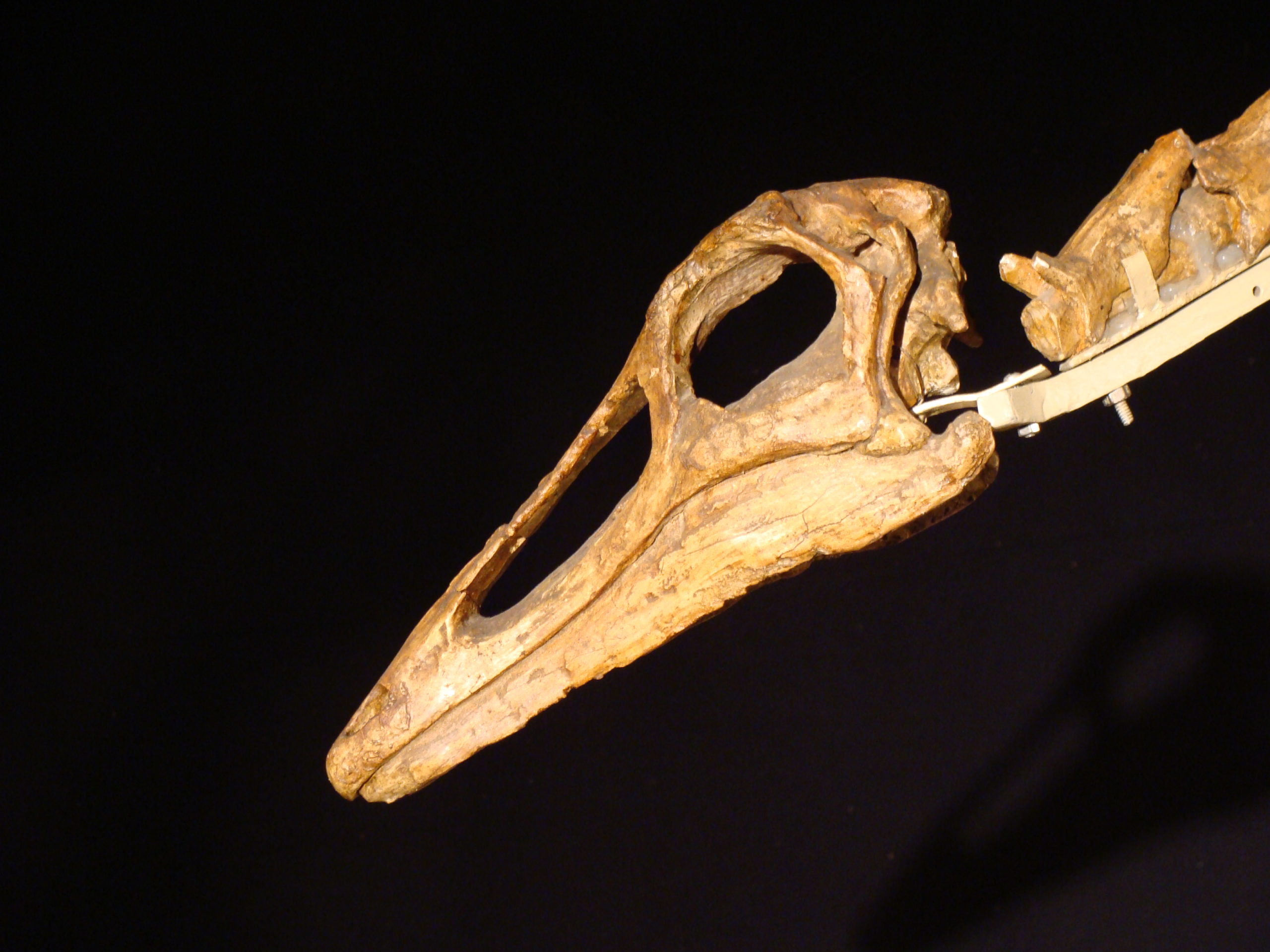
Anserimimimus is a genus of ornithomimid theropod dinosaur that lived in the Late Cretaceous of present-day Mongolia. It was discovered in the late 1970s in the Mongolian aimag, or province, of Bayankhongor during a joint Soviet-Mongolian expedition by Mongolian paleontologist Rinchen Barsbold. In 1988, Anserimimus came from the Latin anser, meaning "goose," and the Greek mimos, meaning "mimic."

It was an omnivorous animal, that is, it ate both plants and meat. It was a lanky, speedy dinosaur that closely resembled other ornithomimids. However. Anserimimus was probably different from other ornithomimids. It had powerful arms with almost straight claws that were only slightly curved, growing from the fingers possible for picking up food. It had large ridges that attach to large arm muscles on its upper bones, such as biceps. 

It probably lived in streams and river channels, marshes and shallow lakes. Anserimimus was about three meters long and weighed fifty kilograms.

What did the Anserimus eat?

It was an omnivorous dinosaur that ate both plants and meat. 

What does Anserimimus mean?

The name means "mimic goose", it comes from the Latin anser meaning 'goose' with the Greek mimos meaning 'mimic'.

When was Anserimus found?

It was discovered in the late 1970s in the Mongolian aimag, or province, of Bayankhongor during a joint Soviet-Mongolian expedition by Mongolian paleontologist Rinchen Barsbold.

Do Anserimimus lay eggs?

Yes, just like any other dinosaur, Anserimimus reproduced by laying eggs. 

Where did they live?

When did they live?

What was your diet?

Who discovered them?

What kind of dinosaurs are they?

What type of species are they?

  • Paul, G.S., 2010, The Princeton Field Guide to Dinosaurs, Princeton University Press p. 113
  • Osborn, H.F. 1917. Skeletal adaptations of Ornitholestes, Struthiomimus, and Tyrannosaurus. Bulletin of the American Museum of Natural History 35: 733-771.
  • Norell, M.A., Makovicky, P.J., & Currie, P.J. 2001. The beaks of ostrich dinosaurs. Nature 412: 873-874.
  • Barsbold, R. 1988. A new Late Cretaceous ornithomimid from the Mongolian People's Republic. Paleontological Journal 22: 124-127.
  • Bronowicz, R., 2005, Upper Cretaceous dinosaur Anserimimus planinychus (Theropoda: Ornithomimidae) from Mongolia. MS Thesis, University of Warsaw
  • Bronowicz, R. (2011). "New Material of a Derived Ornithomimosaur from the Upper Cretaceous Nemegt Formation of Mongolia". Acta Palaeontologica Polonica 56 (3): 477. doi:10.4202/app.2009.1123. 
  • Kobayashi, Y. & Lu J. 2003. A new ornithomimid dinosaur with gregarious habits from the Late Cretaceous of China. Acta Paleontologica Polonica 48(2): 235-259.
  • Kobayashi, Y. & Barsbold, R. 2005. Reexamination of a primitive ornithomimosaur, Garudimimus brevipes Barsbold, 1981 (Dinosauria: Theropoda), from the Late Cretaceous of Mongolia. Canadian Journal of Earth Sciences 42: 1501-1521.
  • Ji Q., Norell, M.A., Makovicky, P.J., Gao K., Ji S, & Yuan C. An early ostrich dinosaur and implications for ornithomimosaur phylogeny. American Museum Novitates 3420: 1-19.
  • Makovicky, Kobayashi and Currie, 2004. Ornithomimosauria. In Weishampel, Dodson and Osmolska (eds). The Dinosauria Second Edition. University of California Press. 137-150.
  • Xu, L.; Kobayashi, Y.; Lü, J.; Lee, Y. N.; Liu, Y.; Tanaka, K.; Zhang, X.; Jia, S. et al. (2011). "A new ornithomimid dinosaur with North American affinities from the Late Cretaceous Qiupa Formation in Henan Province of China". Cretaceous Research 32 (2): 213. doi:10.1016/j.cretres.2010.12.004. 
  • Novacek, M. (1996). Dinosaurs of the Flaming Cliffs. Bantam Doubleday Dell Publishing Group Inc. New York, New York. ISBN 978-0-385-47775-8
geological time 3

Fun Facts

  • The name means "imitating goose", it comes from the Latin anser meaning 'goose' with the Greek mimos meaning 'imitator'.
  • It was an omnivorous dinosaur that ate both plants and meat. 
  • It was a bipedal dinosaur.
  • It probably lived in streams and river channels, marshes and shallow lakes.
  • It has powerful arms that differ from other ornithomimids.

More to Explore!

en_USEnglish

Pin It on Pinterest

Share This

Warning: Undefined array key "paged" in /nas/content/live/abcdino1/wp-content/themes/astra-child/functions.php on line 41