

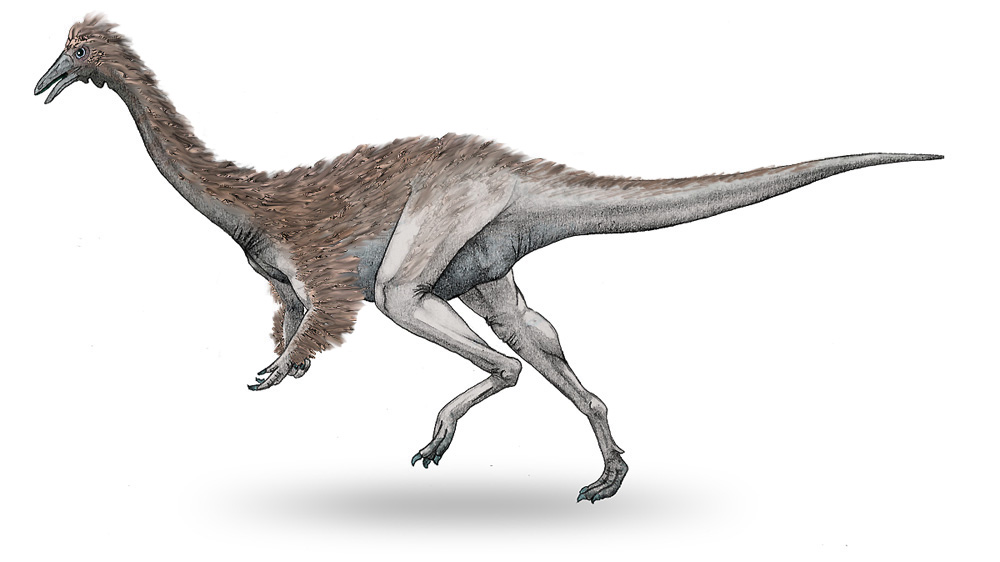


Garudimimus was a genus of ornithomimosaur that lived during the Late Cretaceous in what is now Asia. It was unearthed in the Bayan Shireh Formation by a Soviet-Mongolian paleontological expedition in 1981, and that same year was formally described by Rinchen Barsbold. The name means "Garuda imitator" in reference to its short metatarsus.
It was considered an ornithomimosaur, but unlike others of its species, it had shorter ilia, shorter legs and less developed musculature. It had four toes instead of the "normal" three of other ornithomimosaurs. It is possible that it was omnivorous, that is, it ate both plants and animals in its day. It had a short horn-like crest on the top of its snout, like that of other ornithomimids. It was a bipedal dinosaur, and its hands were used to dig for food.
This dinosaur was approximately 4 meters long and weighed 98 kg.
Garudimimus was a genus of ornithomimosaur that lived during the Late Cretaceous in what is now Asia about 100.5 million years ago - 83.6 million years ago.
The name means "Garuda mimic" in reference to its short metatarsus.
It is possible that he was omnivorous, that is, he ate both plants and animals in his time.


 English
  Español
  Español de México
  Español de Colombia